On the banks of the River Aire next to Kirkstall Abbey a series of willows overhang the riverbank, the catkins are emerging with the first leaves in an alternate arrangement on long slender stems.
Over the past couple of weeks one of my favourite sights of spring has been Willow Catkins. Here are a few pics of the catkins on slender stems. I've recently read a description (although I can't remember where) of willow blossom described as a 'pointillist fuzz' which is spot on (excuse the pun).
I find it difficult to identify the correct species but it doesn't detract from my enjoyment of the flowers which appear before the leaves. Most of the willows around Kirkstall are beginning to lose their flowers as the leaves appear which should make identification a little easier I suppose.
Phil Gates, Cabinet of Curiosities recently blogged about Sallow/Goat Willow/Pussy Willow, how its a dioecious plant, growing as separate male and female trees and its pollination carried out by insects and unusually blue tits, attracted by the nectar.
I think these pics are predominantly Sallow catkins, although I'd appreciate the feedback.
During my lunchbreak I meandered down to St Chad's Churchyard, Far Headingley. Hoping that I might catch a little more butterfly action it wasn't until I decided to head back that I spotted a Peacock on the ground, it sat for a few seconds before I watched it swirl its way up onto the roof of the church. That's three in the area in last four days, starting with the Comma in the woodland, then the Small Tortoiseshell in the churchyard.
In the grounds of the church there are a couple of beautifully designed interpretative boards detailing the range of habitats and the fauna and flora they support. The boards are a collaborative effort by the Green Team of St Chad's, Leeds City Council and Stephen Huxley, designer.
According to the information boards butterflies that frequent the churchyard include, Comma, Small Tortoiseshell (which I saw on Friday), Holly Blue, Wall, Speckled Wood, Gatekeeper. Although today's Peacock isn't mentioned, I'll take that as a positive and look forward to future treats.
Here's the view from the side of the church looking back towards Beckett Park woodland. Native trees such as Willows and Birch are dotted throughout the churchyard.
At the base of a sunny hedgerow, in dappled shade I spotted three clumps of Common Dog Violet, Viola riviniana.
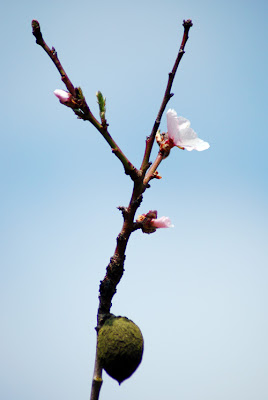
With the blossom opening and the new buds emerging, this Prunus tree still held last year's fruit.
This weekend we visited Potteric Carr for the first time. One of Yorkshire Wildlife Trust'sBig 5 its an extensive reserve of with a range of wetland and woodland habitats, we'd gone with the hope of seeing the Bittern, yet despite a Bittern-less visit we really enjoyed our visit. From the hide we enjoyed close sightings of Gadwall, a Kingfisher, a pair of Little Grebe, Grey Heron and a number of Shelduck.
From the hide nearest the Field Centre the feeding station attracted a large number of Reed Bunting as well as Chaffinch, Robin, Blue Tit, Coal Tit, Pheasant, Blackbird.
There are some lovely patches of Birch throughout the reserve, a tree suited to the poor soils associated with reclaimed mining areas. I love the way they catch the afternoon light in a woodland, the horizontal lenticels of its papery bark becoming more fissured with age.
Plenty of Alder too, like the Birch its a pioneer species and actually belongs to the Birch family. Here the yellow elongated male catkins in the centre and the more rounded darker female catkins. The catkins appear before the leaves.
A great attraction of these kinds of wetland areas especially on a sunny afternoon is the abundance and variety of waterscapes. The reflections of marginal vegetation in the ponds, streams and marshes provide glorious abstract views.