Showing posts with label roe deer. Show all posts

Monday, 6 December 2010

Adel Dam Nature Reserve

On Sunday afternoon we jumped on the bus to Goldenacre Park, how cold it was or rather how cold I was, words cannot convey. Discomfort aside we headed for Adel Dam, a local Yorkshire Wildlife Trust reserve. The Marsh Hide feeders were busy with smaller woodland birds including of a pair of Bullfinch, Nuthatch, Robin, Blue Tits, Long Tail Tit, Great Tit, Coal Tit, along with a sorry looking Magpie, Blackbird, a pair of Moor Hen, and 6 Squirrels, though sadly no sign of the Great Spotted Woodpecker today.


From the second hide, overlooking Adel Dam, only the far reaches of the dam remained unfrozen, kept clear by the current of the inflowing Adel Beck. An assortment of footprints were visible across the frozen surface.


From the left, flying low, heading directly for the unfrozen patch of water zipped the electric blue of a Kingfisher, our first ever sighting of the bird here at Adel Dam. This pic is taken at a distance, but its plumage colouration is unmistakable, it perched here for a few minutes before heading off, hopefully with better luck elsewhere, according to the RSPB website they're particularly vulnerable to hard winters. 


As the Kingfisher made its exit, on the far bank we could just make out the profile of a Roe Deer, well camouflaged amongst the snow and bare branches.


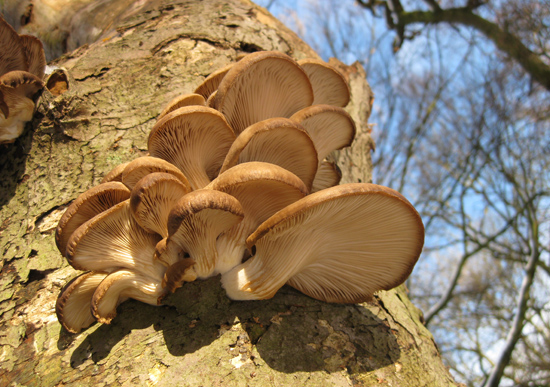
Having endured enough of the cold temperatures made worse by sitting still in the hide for a few minutes, we followed the woodland trail back through the reserve and found this fungi.  I'm guessing its Pleurotus sp. Buff coloured, convex cap, the gills are cream coloured and decurrent, growing in abundant clumps on a deciduous stump. Any help with the ID would be greatly appreciated.




Tuesday, 29 June 2010

Bishop Monkton Railway Cutting

As part of our project to discover more about Yorkshire Wildlife Trust reserves we took a trip out to Bishop Monkton Railway Cutting, a limestone habitat, part of the former London and North Eastern Railway (LNER), Harrogate to Ripon Line which closed in 1967. One of our first sightings and a first for the year was this Ringlet (Aphantopus hyperantus), a dark brown butterfly with white fringed wings and light coloured rings on the underwing.


I do like an interpretive board and the Yorkshire Wildlife Trust never disappoint.


Here's a view of the railway cutting, the vegetation comprised Marjoram, Common spotted orchid, Thistles, Birds Foot Trefoil, Wild Strawberry, Nettle, White Campion, Buttercup, Thistles, Self Heal, Ox Eye Daisy, Brambles, Hawthorn, Elder, Willow.


I'm not so good at identifying orchids but the interpretive board highlights Common Spotted Orchid as a prevalent species.


At the far end of the track we encountered two Roe Deer, they stood chomping away for a couple of minutes before leaping out of view.

We were a week or two early for most of the flowering plants, but I imagine the marjoram and thistles attract a large number of butterflies. During our wander, as well as the Ringlets we saw Meadow Brown, Silver Y moth, Green Veined White, Speckled Wood, Small Tortoiseshell and I understand that 19 species of butterfly have been recorded over the years. Although we came away without any decent pics of the feathered inhabitants we did see a family of Long Tail Tits, Whitethroat, Blackbird, Great Tit, Blue Tit. A great little reserve to visit on a sunny day.

Sunday, 23 May 2010

Rodley Nature Reserve

On Saturday we enjoyed a gloriously warm afternoon jaunt to Rodley Nature Reserve. The grasses that had just started to flower last week were fully flowering today, and looked striking against a clear blue sky.


We stopped off for a cold drink at the Vistors Centre and marvelled at the webcam stream from the Blue Tit box. I think there were eight or nine babies, an adult appearing every few minutes, the volunteers reckon they'll have fledged by mid next week. From inside the Visitors Cente we could see this Crow sat on a gatepost open beaked in an attempt to cool down.


By the Dragonfly Ponds Large Red Damselflies were busily going about their business.


And here a ropey pic of a blue damselfly, perhaps a male Azure Damselfly? Slightly different to a Common Blue in which abdominal segments 8 and 9 are all blue. Any thoughts appreciated.


Butterfly sightings included 3 Green Veined White, 3 Small Tortoiseshell, 4 Speckled Wood, 3 Orange Tip, 2 Peacock, this one here sat close winged on a fence post, plus 8 unidentified Whites on the wing.


From the lookout point overlooking the Wet Grassland we could see this Roe Deer on the opposite bank, it stood for a minute before bounding over the verge towards the riverbank, providing us with our first sighting of a Roe Deer at Rodley, thank you very much.

Monday, 14 September 2009

North Cave Wetlands, Deer

At the weekend we paid a visit to North Cave Wetlands, a Yorkshire Wildlife Trust Nature Reserve in the East Riding of Yorkshire. As the name suggests a series of wetland habitats are the dominant features, but it was a wooded path that provided the backdrop to our best sighting of the day. This pair of Roe Deer.


They looked as if they were out for a weekend stroll, chatting about this and that.


We remained still & after a short while the deer the deer spotted us and sought out an alternative route through the hedgerow, bounding off into an adjacent wheat field & into nearby woodland.

Friday, 7 August 2009

Warkworth

We stopped off at Warkworth for a cuppa and a stroll to the beach, within minutes of our walk we spotted a Roe Deer in a field adjacent to the beach road. It made its way slowly through the field & paused to feed in the hedgerow. Its coat matched the colour of the dock weeds dotted throughout the field.
Here its is to the far right of the pic almost hidden within the first patch of foliage and Coquet Island in the background (I like a bit of context now and again).

On the approach to the dunes this eye catching male Stonechat (thanks to Rambling Rob for very graciously alerting me to my initial bloomer)settled in a tree & then kindly perched atop the Public Footpath signpost.

As we walked up a steep North West facing dune the sun broke through and transformed the area into Butterfly central. Dotted with 12 or 14 Burnets a number of them in pairs, Small Whites fluttered around, a small blue butterfly flew at a distance, a couple of Small Skippers.

Small Skipper

6 Spot Burnet moth, Zygaena fillipendulae. Its a daytime flier, identified by 3 pairs of red spots on each wing. Caterpillars feed on trefoil and vetch which contain traces of cyanide, a nifty strategy to deter predators. The club shaped antennae can be seen clearly.

A patch of dainty Harebells

Large White, Pieris brassicae

A weather worn Red Admiral Vanessa atalanta on a flowering Teasel

On the borders of the marshland a Spinach moth Eulithus mellinata. The moth holds its wings at an angle to its body, with the hindwings virtually hidden behind the forewings.

On the banks of the River Coquet near the bridge. A mandarin duck Aix galericulata which I didn't notice it at first. What a pretty duck!

Wednesday, 22 July 2009

Beckett Park, Headingley

Working at Headingley Campus during last week's Graduation ceremonies gave me the opportunity to incorporate a daily mini-nature ramble on my way to work, yay! Monday got off to a good start with a Great Spotted Woodpecker in Beckett Park woodland, although an unfortunate operator error resulted in a lack of pictorial evidence, whoopsy! On Friday a healthy looking fox cub crossed my path just metres away. Yet again the eye was quicker than the hand & foxy was off before I had the chance to say cheese.

A blooming Buddleia on Queenswood Drive playing fields attracted this healthy looking Painted Lady.


This time last year during Graduation week I caught sight of a Roe deer on Beckett Park, a mere stones throw from Headingley Campus.

In woodland behind St Chad's churchyard I caught sight of a Jays rear end! The Jay re-appeared later in the week, jumping down from the branches of a beech to feed from the ground only a few metres away and although generally a shy bird it didn't seem too bothered by my presence.

The first ripe blackberry of the year on brambles near Headingley train station.

In woodland behind St Chad's churchyard this beech tree was covered in bracket fungi.

On campus, near the tennis courts an abundance of tiny Fairy Ring Champignon which have become a familiar sight over the past couple of weeks.

Related Posts Plugin for WordPress, Blogger...